
Folding-Arm Awnings
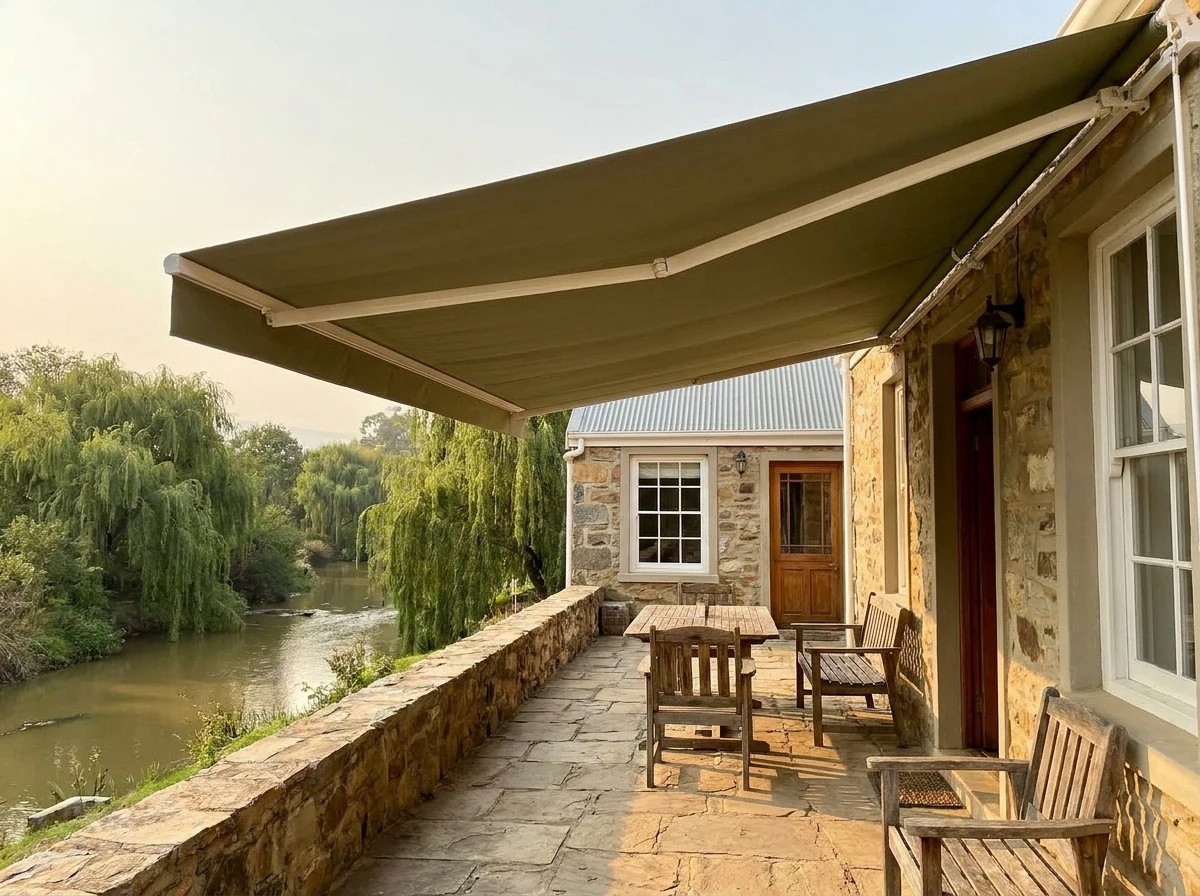
No posts, no permanent roof — shade over the table when the sun's baking the patio, gone again in seconds the moment the wind turns.
Why this coast wants one
A baking north- or west-facing patio turns back into a usable room in summer, and retracts to let the low winter sun through when you actually want it — the seasonal flexibility a fixed roof simply can't offer. No posts means no interrupted sea view and no obstacle in the middle of the entertaining space.
02Motor and wind sensor — not optional here
An awning caught open in a south-easter or a winter cold-front gust doesn't survive it. On the Whale Coast we treat motorised control with automatic wind-sensor retraction as the responsible spec, not an upgrade — full cassette housing is the default anywhere directly exposed, sealing the fabric and arms away from salt air and weather when retracted. Solution-dyed acrylic fabrics hold their colour under the UV load this coast gets.
03Sized to the space, not a standard width
Projection runs to roughly 3–4m over wide spans, so most Whale Coast patios and decks are covered in a single unbroken sweep. Crank-handle control suits a sheltered inland patio like a Stanford courtyard; anywhere facing open water gets motorised as standard.
- Motorised with wind-sensor auto-retract as standard near open water
- Full cassette housing on directly exposed installations
- Solution-dyed acrylic fabric, colour-stable under strong UV
The honest limitations
An awning is a shade product, not a rain product — it copes with light drizzle at a pitch, never a storm or standing water. Wind ratings are real limits, not marketing language, and the fixing substrate (brick, timber, render) changes what's possible, which is exactly what the site visit is for.
From Stanford's sheltered river courtyards to Gansbaai's exposed decks, awning specification changes with exposure — we read the site before we quote the control.
Shade your patio for real
Free in-home measure, a full written quote, no obligation.
Book your free measure